Why Flutter is NOT a MEAN STACK APPLICATION Step-by-Step Guide for beginners
If you’re new to development, you might have come acr
If you’re new to development, you might have come across terms like Flutter and MEAN Stack and wondered if they are related—or even the same thing. The short answer is: Flutter is not a MEAN Stack application, but they can work together in a modern app architecture.
In this beginner-friendly guide, we’ll break everything down step by step so you clearly understand what each one is, how they differ, and how they can be combined.
In modern web development, the term MEAN Stack refers to a powerful combination of technologies used to build complete, end-to-end web applications. A MEAN Stack application is a full-stack solution that handles everything from the user interface to server-side logic and data storage using JavaScript.
Flutter means?
Flutter is a UI toolkit developed by GOOGLE that allowance developers to build cross platform applications using a single codebase thing to
The word “MEAN” is an acronym for four key technologies: MongoDB, Express.js, Angular, and Node.js. Each of these tools plays an important role in the development process. Angular is responsible for creating dynamic and interactive user interfaces, Node.js and Express.js handle the backend logic and server operations, and MongoDB is used to store and manage data efficiently.
#another Key Features of Flutter:
Build apps for ;
*android
*ios
*Web
*Desktop
Usage Dart of programming language
*Fast performance language
*Fast performance with the native like experience
*Rich UI components WIDGETS
Simple into ;
FLUTTER is used to build the front end users interface of an app
What makes the MEAN Stack unique is that it uses JavaScript across the entire application, allowing developers to work with a single language for both frontend and backend development. This not only simplifies the development process but also improves speed, scalability, and maintainability.
In simple terms, a MEAN Stack application is a modern web application built using these four technologies, working together seamlessly to deliver a fast, scalable, and efficient user experience.
Why beginners love Flutter ?
*Easy UI building with widget
*Fast development
*Clean and modern design
What is the MEAN Stack?
The MEAN Stack is a full stack JavaScript framework used for building web and backend applications .are to known as mean stack application
One of the biggest advantages of a MEAN Stack Application is that it uses JavaScript throughout the entire development process. This means stack application developers do not need to switch between different programming languages, making development faster and more efficient. It also allows for better code sharing, easier debugging, and improved team collaboration.
Consists of ;
In a typical MEAN Stack Application, the flow works like this: a user interacts with the frontend interface built using Angular. This action sends a request to the backend server powered by Node.js and Express.js. Into the Mean stack application The server processes the request, interacts with MongoDB to retrieve or store data, and then sends a response back to the frontend. Finally, Angular updates the user interface based on the response received. Mean stack application known as.
MEAN Stack Applications are widely used in real-world scenarios such as e-commerce platforms, social media applications, content management systems, and real-time applications. Mean stack applications heir scalability and flexibility make them a popular choice for startups as well as large enterprises.This seamless communication between frontend, backend, and database makes MEAN Stack Applications highly efficient and responsive. It is especially useful for building Single Page Applications (SPAs), where users can navigate through the app smoothly without experiencing page refreshes.
Another reason for the popularity of MEAN Stack Applications is their scalability and flexibility. MongoDB’s schema-less design allows developers to easily modify data structures as requirements change, while Node.js ensures high performance by handling multiple requests efficiently. Angular, on the other hand, provides a structured framework for building large-scale applications with reusable components.
MEAN Stack Applications are widely used in real-world scenarios such as e-commerce platforms, social media applications, online learning systems, and content management systems. Startups and enterprises prefer this stack because it supports rapid development and can handle growing user demands effectively.
In addition, the open-source nature of these technologies makes them accessible and cost-effective for developers. A large community of developers continuously contributes to improving tools, libraries, and frameworks, making it easier to find support and resources when building applications.
In conclusion, a MEAN Stack Application is a modern, full-stack web application built using MongoDB, Express.js, Angular, and Node.js. It offers a streamlined development process, high performance, and excellent scalability, making it one of the most popular choices for building dynamic and interactive web applications today.
- MongoaDB – Database
- Express.js – Backend framework
- Angular – web frontend
- Node.js – Server runtime
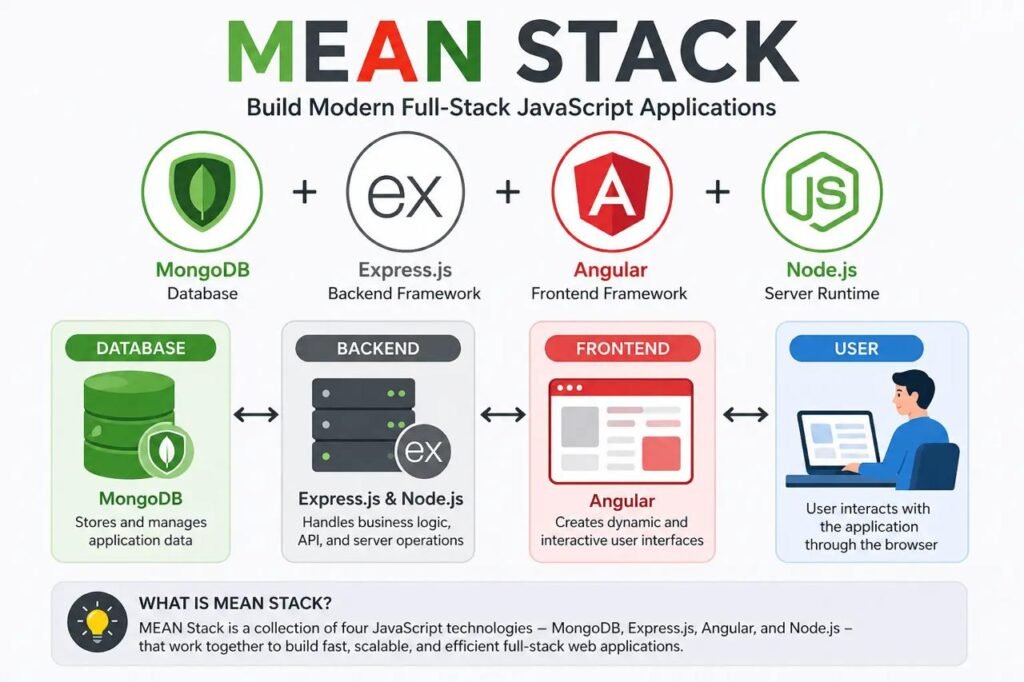
Components of MEAN Stack Application
- MongoDB – Database Layer
MongoDB is a NoSQL database that stores data in a flexible, JSON-like format.
Key Features:
- Schema-less structure
- High scalability
- Fast performance
- Easy data handling
MongoDB is ideal for applications that require frequent updates and flexible data storage
- Express.js – Backend Framework
Express.js is a lightweight backend framework used with Node.js.
Key Features:
- Handles HTTP requests
- Simplifies routing
- Middleware support
- Fast and minimal
It acts as the bridge between frontend and database.
- Angular – Frontend Framework
Angular is used to build dynamic and interactive user interfaces.
Key Features:
- Component-based architecture
- Two-way data binding
- Single Page Application (SPA) support
- Real-time updates
Angular ensures a smooth and responsive user experience.
⸻
- Node.js – Server Runtime
Node.js allows JavaScript to run on the server side.
Key Features:
- Non-blocking architecture
- High performance
- Handles multiple requests efficiently
Node.js powers the backend of a MEAN Stack Application.
How a MEAN Stack Application Works
Understanding the workflow of a MEAN Stack Application is important.
Step-by-Step Flow:
- The user interacts with the frontend (Angular)
- A request is sent to the server
- Node.js + Express processes the request
- Data is retrieved or stored in MongoDB
- The server sends a response back
- Angular updates the UI dynamically
This creates a smooth and fast user experience
Advantages of MEAN Stack Application
- JavaScript Everywhere
Developers use one language (JavaScript) for the entire application.
- Fast Development
No need to switch between multiple languages.
MEAN stack applications can handle large-scale systems.
- Flexibility
MongoDB allows flexible data storage.
- Open Source
All technologies are free and widely supported.
Why Flutter is Popular
* Single codebase for multiple platforms
* Fast development with hot reload
* Beautiful UI with customizable widgets
* Strong community support
Flutter vs MEAN Stack – Are They the Same?
Not exactly.
* Flutter is mainly used for frontend (UI development)
* MEAN Stack is a full-stack solution (frontend + backend + database)
When Flutter is combined with backend technologies (like Node.js + MongoDB), it can function like a MEAN stack application.
Step-by-Step: How Flutter Works Like MEAN Stack
Let’s break it down clearly.
Step 1: Frontend Development
In MEAN stack, the frontend is built using Angular.
In Flutter:
* UI is built using widgets
* Everything is customizable
* Apps look modern and smooth
Flutter replaces Angular here.
Instead of:
* Angular (MEAN frontend)
* Flutter UI
Step 2: Backend Development
In MEAN stack, backend is handled using:
* Node.js
* Express.js
Flutter doesn’t handle backend directly. So we integrate:
* REST APIs
* Firebase
* Node.js backend
The means Flutter connects to backend services just like Angular does in MEAN.
Step 3: Database Integration
MEAN stack uses MongoDB.
In Flutter apps, you can connect to:
* MongoDB
* Firebase Firestore
* MySQL
Database functionality remains similar.
Step 4: API Communication
Both Flutter and MEAN stack application rely on APIs.
In Flutter:
* You use HTTP requests (GET, POST)
* Fetch data from backend
* Display it in UI
How Angular communicates in MEAN stack.
Step 5: Full Application Flow
Let’s compare both:
MEAN Stack application Flow:
1. Angular → UI
2. Node.js + Express → Backend
3. MongoDB → Database
Flutter-Based Flow:
1. Flutter → UI
2. Node.js / Firebase → Backend
3. MongoDB / Firestore → Database
Similarity?
Flutter replaces Angular, and everything else stays almost the same.
Why Flutter Can Be Considered Like MEAN Stack
Here are some key reasons:
1. Full App Development Capability
Flutter + Backend + Database = Full-stack app
2. API-Based Architecture
Both use REST APIs for communication
3. Scalable Structure
Flutter apps can scale just like MEAN apps
4. Real-Time Data Support
Using Firebase or WebSockets, Flutter supports real-time apps
Advantages of Using Flutter Instead of Angular
1. Cross-Platform Development
Angular → Web only
Flutter → Mobile + Web + Desktop
2. Better Performance
Flutter compiles to native code
→ Faster than many web apps
3. UI Flexibility
Flutter gives pixel-perfect cont
4. Faster Development
Hot reload speeds up coding
When Should You Use Flutter + Backend (MEAN-like)?
Use this approach if you want to build:
* Mobile apps with backend support
* Real-time apps (chat, social media)
* E-commerce apps
* Startup MVPs
When MEAN Stack application is Better
Choose MEAN stack if:
* You are building web-only applications
* Your team is strong in JavaScript
* You need SEO-friendly web apps
Real-World Example
Using MEAN Stack application
* Angular → Website
* Node.js → Backend
* MongoDB → Database
Using Flutter + Backend:
* Flutter → Mobile app
* Node.js / Firebase → Backend
* MongoDB → Database
Real-World Use Cases
MEAN Stack Applications are widely used in:
- E-commerce platforms
- Social media apps
- Online learning systems
- Content management systems
Many startups prefer MEAN stack due to its speed and flexibility.
MEAN Stack vs Other Technologies
MEAN vs MERN
- MEAN → Angular
- MERN → React
Both are similar, but frontend differs.
Why Choose MEAN Stack Application?
You should choose a MEAN Stack Application if:
- You want full-stack development
- You prefer JavaScript
- You need scalable applications
- You are building dynamic web apps
Challenges of Using Flutter Like MEAN Stack application
Flutter is powerful, there are some challenges:
1. Backend Dependency
Flutter needs external backend services
2. Learning Curve
You need to learn:
* Dart (Flutter)
* Backend (Node.js/Firebase)
3. Larger App Size
Flutter apps can be slightly bigger in size
Future of Flutter + MEAN Stack application Concept
The future looks promising.
Many companies are now:
* Using Flutter for frontend
* Using Node.js for backend
* Using MongoDB or Firebase for database
Conclusion
Flutter is not technically a MEAN stack application, but it can act like one when combined with backend technologies.
Angular in MEAN = Flutter in modern apps
Node.js + MongoDB remain the same
Architecture remains similar
If you’re a beginner:
* Learn Flutter for UI
* Learn Node.js for backend
* Learn MongoDB for database
This combination will help you build full-stack, real-world applications just like MEAN stack application but even more powerful.
Final Thoughts
If your goal is to build modern, scalable, and cross-platform apps, Flutter is a great choice.
Instead of thinking “Flutter vs MEAN”, think like this:
“Flutter + Backend = New Generation MEAN Stack”
If you are a beginner and would like to know about AI automation, Visit my blog