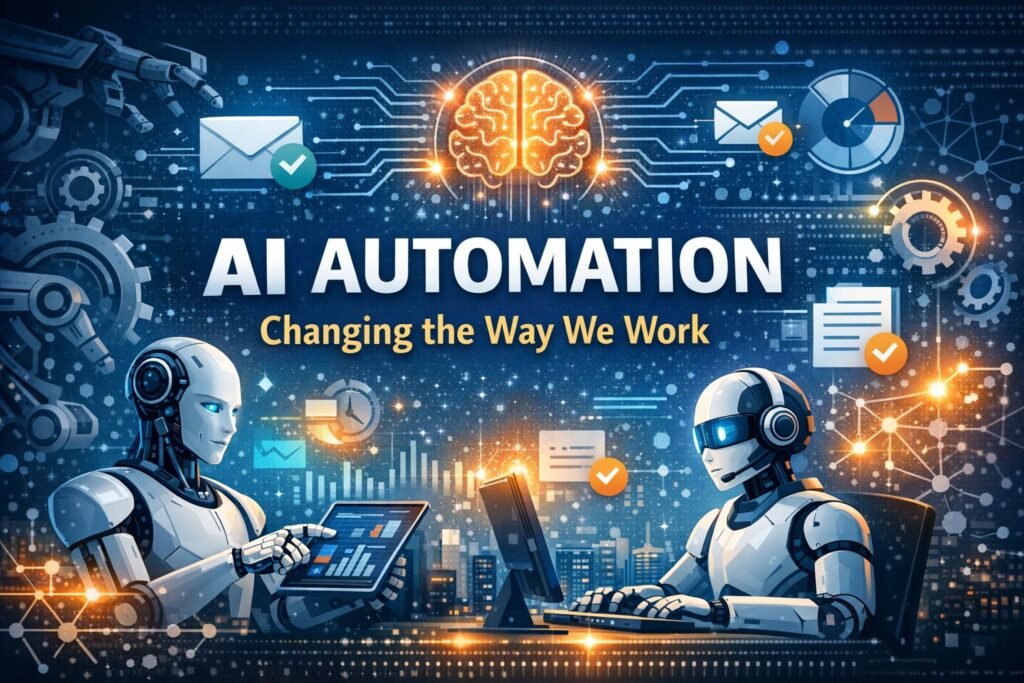
Changing the Way We Work at AI Automation
The thing is, technology doesn’t wait for anybody. And the reality today is that one of the greatest game-changers that we are experience-caring as far as technology is concerned is Al automation.
AI automation means that intelligent machines can perform tasks automatically without human intervention. These systems can interpret data, learn from data, adjust to changes, and do tasks with very little or no input from humans.
Automation powered by Artificial Intelligence (AI) is readily available to users and can now comprehend their inquiries instead of simply carrying out their requests.
AI is capable of performing this task by using Machine Learning and Natural Language Processing to decode how individuals ask questions – even though their queries may be incomplete or formatted differently from other inquiries previously. Rather than returning a static response, AI Automation attempts to discover users’ intent and context of past interactions with them when delivering timely and relevant responses. By being able to understand the user’s intent, AI systems like chatbot, voice-activated assistant, and recommendation engine can interact in a much more conversational manner with users and as a result, make their interaction with machines much easier and ultimately more user-friendly.
But, What is Actually Al Automation
Consider Al automation as having an intelligent assistant that can take care of those boring tasks that you wish would just go away. It relies on artificial intelligence that works on handling tasks that took up so much of your time before. And the best part? It can learn from the tasks it’s doing, can make decisions independentlv, and can run solo without having to monitor the minute details.
AI Automation is a technique in which computer systems utilize artificial intelligence to execute tasks automatically. They can interpret and analyze information, learn from previous experience, adapt to changes in their environment, and perform their tasks with minimal or no involvement from human beings.
You May Have Already Seen It in Action
Al automation is all around us, whether we recognize it or not:
Customer service chatbots that can finally understand your questions.
Email answers that write themselves (not those robotic ones). Data entry and reports that can be done while you focus on more pressing matters. Posts that can be scheduled to publish just as they are meant to. And even content and images with just an instruction or two.
But what is Al automation, really?
Consider Al automation to be much like having one of the brightest assistants ever by your side, never tired or losing focus, and able to perform all the routine tasks with unmatched efficiency. Al Automation selectively integrates Artificial Intelligence together with Automated Processes to achieve those tasks which hitherto always required human intervention.
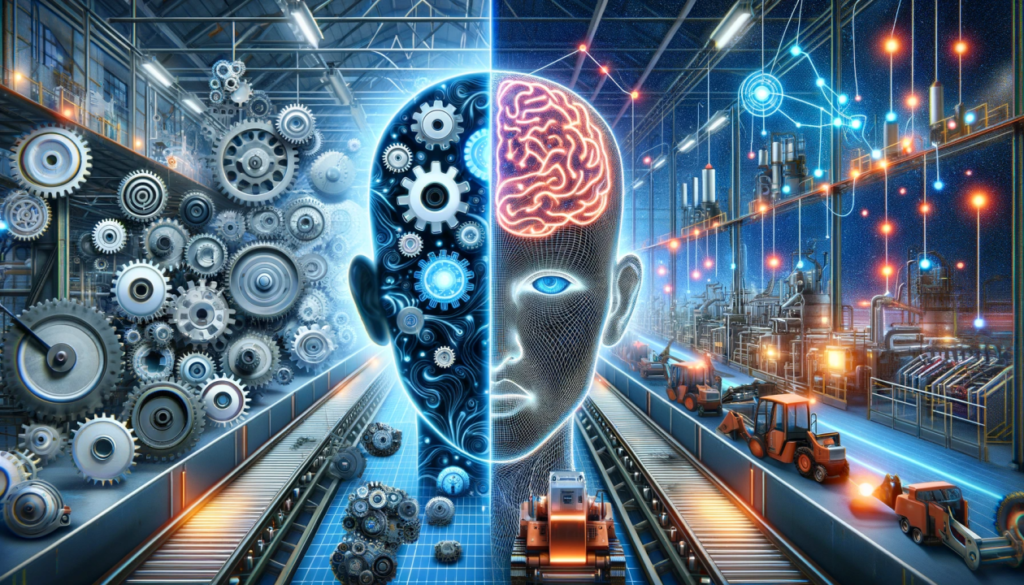
While traditional automation follows fixed rules of operation, Al automation learns, adapts, and improves with time. This latter analyzes patterns, understands the data provided, and makes subsequent decisions based on what has happened in the process. This implies that the more it works, the smarter it gets.
Artificial intelligence (AI) automation is here to stay. Companies can now accomplish tasks much too efficiently, quickly and accurately to ever be able to service their clients as they do now without utilizing AI for their processes. Companies that choose to utilize AI automation will be able to provide a superior level of service than would otherwise be possible.
Let’s define Al automation by explaining what it’s
Reduces manual work
Enhances accuracy
Reduces time
Machines and software powered by AI are changing the way we work by enabling us to perform most of the activities we are doing today faster and more efficiently than ever before through automation. By using AI automation, we can automate repetitive tasks so that we can spend less time doing these tasks and more time doing more complex tasks that enable us to provide better service to our customers.
Enables the system to operate by itself.
Aids in focusing on high-priority tasks
Rather than spending hours on tasks that involve repetition, you can now automate these using Al while pursuing your creativity and growth.
Why Al Automation Matters Today
The modern workplace is fast-paced. Expectations are high, deadlines are tight, and multitasking is expected. This is exactly where the value of Al automation comes in.
Time remains one of the greatest resources we possess. Automation in Al helps recapture time invested in work that must be done but that uses up so much of our productive time. Whether answering e-mails, data organization, or even managing schedules, automation reduces workload without compromising quality.
More importantly, Al automation reduces human error. Data entry, report generation, and system monitoring-all of these are prone to mistakes when performed by humans. Al systems can do performed by humans Ai system can do such activities
Q: What is the future of AI automation?
A:
Because of AI automation, the future of work is being transformed. This technology makes any work faster, smarter, and more efficient. This makes it easier to reduce human efforts and focus more on creative work.
Q: Why is automation with AI so important?
AI Automation improves efficiency, reduces repetitive work, increases productivity, enables smarter decision-making, improves accuracy and saves time to help businesses and individuals confidently adapt to an evolving digital future.
Q: What is the effect of AI-related automation on work?
A: AI automation helps in simplifying processes, reducing errors, saving time, increasing productivity, innovation, assisting in human creative processes, and maintaining competitiveness in the digital technology-driven world.
Q: Why should businesses today consider implementing AI automation in their operations?
A: AI technology enables simplification in operations, minimizes the cost of operations, helps improve accuracy, promotes efficiency, leads to time conservation, helps in growth decisions, empowers employees to work with capabilities, and prepares the organization to work in the rapidly changing digital world.
Real-World Uses
AI Automation has many real-world applications. It is now used for customer service by using AI chatbots for thousands of questions and answers in a single session. For example, it will generate targeted email marketing campaigns, schedule social posts, and run advertising campaigns for businesses in the marketing department; however, it is also used heavily in finance by detecting fraud as well as managing multiple transactions at once and in the healthcare sector to help doctors analyze patient data quicker and more effectively.
Advantagest of AIAutomatedSystems
Automation of AI will speed up production and productivity through automation faster than human production output. It reduces possible errors as well as reduces/cuts operating expense and allows for round-the-clock continuous operation. Businesses have the ability to scale their staffing requirements up and down based upon the ability of AI to manage and complete larger volume output without increasing headcount.
Impact on Businesses
Businesses will be able to create strategy in the avoidance of repetitive tasks. Artificial Intelligence (AI) Automation can also improve customer experience, increase revenue, enable data-driven decision making and help with overall business success.
Advancement in technology is continuing to increase the complexity and capabilities of AI Automation. In turn, AI Automation will also have the ability to perform more complex work, resulting in improved efficiency in business operations. Organizations that are early adopters of AI Automation can expect to be at an advantage in terms of competition in the ever-increasingly digital marketplace.
AI Automation is likely to become one of the most significant technologies of the digital age that will change how businesses operate, how customers get served, and how we do our work. Using automation and artificial intelligence, businesses will be able to build systems that not only perform tasks autonomously but also can think, learn, and evolve.

The diverse number of advanced technological implementations that fall under the umbrella of Artificial Intelligence Automation include:
- Learning Machines: This allows a machine to modify its configuration in accordance with how it was configured using previous data and provide an automated means of configuring itself.
- Natural Language Processing (NLP): Provides an AI with the context that it requires to understand the speech patterns and meanings of people, so an AI has the capability to transform the experience that people have in using a chatbot or voice assistant.
- Computer Vision: This is a way for machines to interpret visual input (pictures or videos) in order to recognize what is occurring within a picture/video.
- Robotic Process Automation (RPA): Automates repetitive digital tasks performed on a worker’s computer keyboard, mouse, etc. through the use of an automated machine.
Collectively, these new technology developments provide AI Automation technology the respective attributes of both advanced sophisticated functionality and the ability to produce results through the application of artificial intelligence.
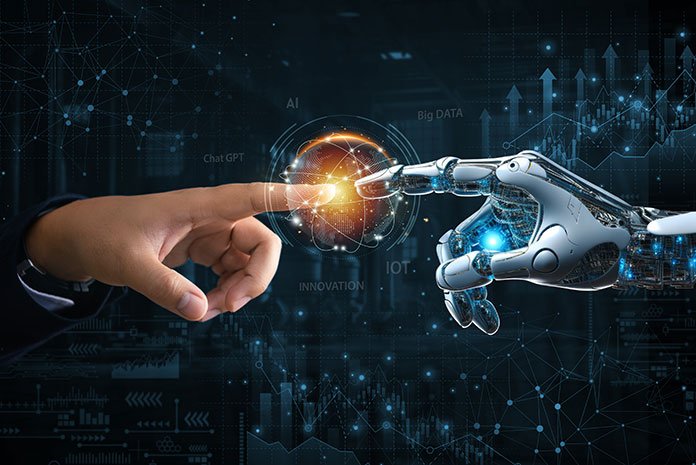
Artificial Intelligence (AI) automation refers to the degree in which computer programs and other devices use AI to perform tasks without the need for human intervention. Essentially, this type of automation allows machines to simulate human thought processes by utilizing analytical data to develop their own understanding of how best to respond in a situation, and then to use that data to make decisions as would a human being, only much faster and more accurately.
Unlike “traditional” automated systems that rely exclusively on well-defined processes, procedures and/or rules; AI-based automated systems are both intelligent and capable of learning from their experiences to identify recurrent patterns, recognize the likely outcomes of a given decision, and continuously improve their capabilities of performing their designated duties. As a result, AI automation enables businesses to significantly improve their ability to serve customers and create new marketing campaigns, improve data analysis, and make better decisions.
Organizations from every segment of the digital and technology marketplace can find AI Automation as a key component of their business operations – including chatbots, digital marketing, online retail/e-commerce, banking, healthcare, and the overall business process – with tangible benefits such as gains in operational efficiency, reduced incidence of error, increased levels of customer satisfaction, and enhanced productivity.
In summary,
AI Automation represents the intelligent execution of automated technology based on AI capability thaRobyn O’Brien is the founder of O’Brien Consulting, which has been established to offer the expertise, experience and knowledge of what is required for all Fortune 500 companies and government agencies to produce high-quality products and services through the enhancement of collaborative processes, communication processes and the overall strength of each functional area of their operations around the world. In addition to her consulting work, Robyn is a published author and speaker on several topics related to process improvement and has received numerous awards for her contributions to process improvement through extensive writing of both published resources in journals and books.
Artificial Intelligence (AI) Automation is the next major advancement in the Digital Age. Businesses from all over the world are using AI technologies to expedite task processing, reducing the amount of human resources needed to perform a task and decreasing accuracy from human errors while allowing organizations utilise the data provided from AI systems to develop into superior decision makers, provide better customer service and achieve greater productivity.t allows for completion of tasks without having to directly participate in their execution.
Benefits of Using AI Automation
Time Savings
Compared to people, the speed of completion of work through AI Automation is significantly greater.
Error Reduction
Mistakes typically associated with manual work are avoided by using AI Automation.
24/7 Operation
AI Systems are able to operate constantly, without the need for taking breaks during an entire day and night cycle.
Increased Productivity
AI Automation allows more things to be accomplished in less time than previously possible by using human labour.
Cost Effectiveness
Uses of AI Automation permit businesses to reduce their costs associated with human resources and day-to-day operations.
Improved Customer Service
AI Chatbots can provide timely responses to customers’ questions and assist them in whatever way possible.
Data Analysis
AI is capable of processing large volumes of data very quickly and efficiently.
Better Decision-Making
Using AI, managers are able to make informed decisions because of the accurate information provided by AI.
Scalability
As a company continues to scale, the use of AI Automation will allow them to take on additional workloads.
Consistent Quality
AI Automation will continue to provide consistently high levels of output, regardless of the number of units produced, at all times.